A lot has happened at Maskin Mekano recently. New machines have been added, existing models now fit together more logically, and there is suddenly much more choice in the "middle ground" between small and large. That's good news, but it also makes it more difficult to quickly see exactly what each machine is intended for.That's why we're taking a moment in this blog to clearly outline the range. Which models are available, what's new about the ECO1, ECO4, and SH 902, and how do they compare to the rest? The goal is that after reading this, you'll be able to say in plain recycling language: this suits my material, my location, and my desired fractions.
The main difference between ECO and SH
The quickest way to understand Maskin Mekano is to divide the machines into two families.
ECO models are mobile screening installations with a bunker (hopper). You can load them directly with a shovel. In practice, this bunker is more than just a "container"; it ensures a smooth, even supply to the screen box. This improves the screening quality, prevents the screen box from constantly emptying, and gives you, the operator, a better rhythm at work.
SH models are screening machines without a bunker. They are usually placed behind a crusher or under a conveyor belt. They are typical secondary screens, often used to sharpen end products or to neatly screen out the fine fraction. In practice, they are also often referred to as "fine fraction screens," especially when the focus is on effectively separating sand, 0-10, 0-20, or similar products.
Important to know: Maskin Mekano also supplies separate bunkers and feeders. So if you want to use an SH but you do want a decent supply and a small stock for the sieve, you can solve that with a separate bunker or feeder unit.
Within the ECO series, you see logical growth: from compact and simple to larger and more productive. The addition of the ECO1 and ECO4 completes the lower and middle segments in particular.
The ECO1 is the smallest in the range and works with a single-deck screen. This is the machine for situations where you don't need three or four products, but just two distinct fractions. For example, removing oversize material and retaining a fine fraction, or separating a coarse fraction from sand.
The screening box has a screen area of 1.2 x 2.2 meters. Its compact size and simple design make it a logical replacement for a small drum screen in situations where you mainly process two fractions. The ECO1 is also easy to move on a hooklift chassis, which makes it interesting for smaller locations, temporary projects, and companies that often move between jobs.
For many companies, the ECO2 is the practical all-rounder in the compact segment. It has a bunker, can be loaded directly with a shovel, and can work with multiple sieve decks to produce multiple fractions. The sieve box measures 1.2 x 2.2 meters, just like the ECO1, but the ECO2 is designed for greater flexibility in fractions and deployment.
On smaller recycling sites, for demolition and infrastructure projects, or for sifting sand and rubble, this is often exactly the size you want: compact, quick to deploy, but with full screening capability.
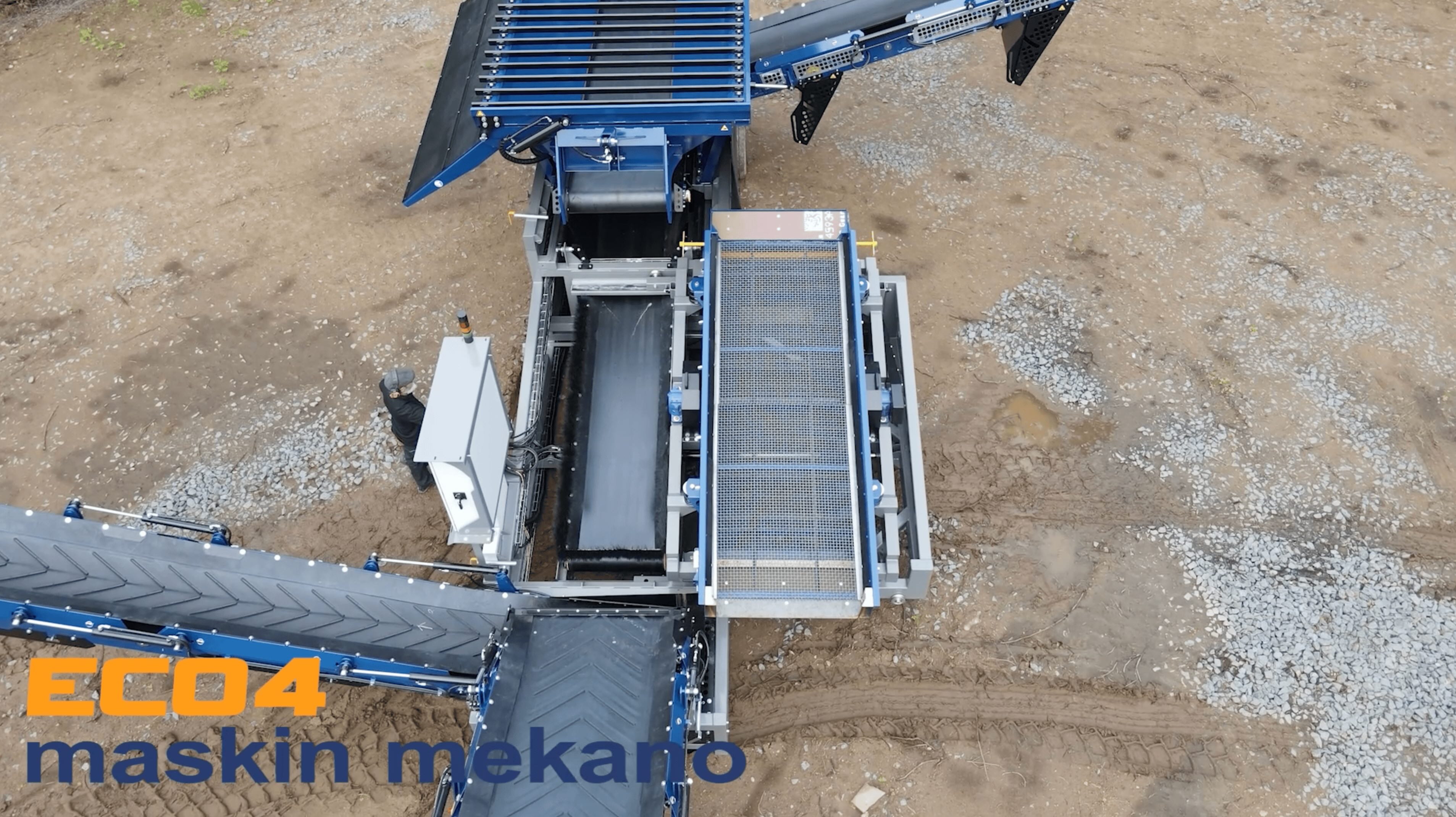
The ECO4 is an important addition because it fills the gap between "compact" and "serious production". You get more screen area than with the ECO2. The screen area is 1.2 x 3.3 meters. On paper, that may seem like a small step, but in practice you will immediately notice the difference in capacity, especially if fine fractions are important to you.
What makes the ECO4 particularly interesting is that the design is explicitly geared towards practical use, including a pull-out sieve box. This saves time when changing sieve decks and performing maintenance, and makes the machine convenient if you regularly change sieve decks or mesh sizes.
The combination of bunker and sieve box makes the ECO4 also effective for materials that you would normally process with a drum sieve, such as compost and sand, while the vibrating sieve allows you to achieve a fine fraction.
The ECO6 is the step where you really start to process volume on a structural basis. The screen box has a screen area of 1.4 x 4.8 metersand the machine is mounted on a trailer chassis, making it easy to transport behind a truck. The bunker keeps it an independent screening installation, but in a class that is well suited to rubble, concrete, and natural stone, and to companies where the screen does not have to be "flexible," but simply has to keep running.
If you already have a crusher or a fixed conveyor belt, you often don't want a screen with a bunker. You want a screen that you can place behind the crusher to refine products or to properly screen out a fine fraction. That is exactly what SH machines are designed for.
The SH 902 is new and fills a gap that many people found lacking in practice. The screen box measures 1.2 x 4.4 meters. This puts it clearly above the ECO4 in terms of screen length, but still below the ECO6 class. This makes the SH 902 interesting if you do need more screen surface area, but want to remain compact and already have a supply from a crusher or conveyor belt.
In addition, this machine is relatively easy to move around on site, making it well suited for mobile lines or situations where you regularly change setups.
The SH1202 and SH1203 are in the same screen box class as the ECO6. They have a screening area of 1.4 x 4.8 meters, but without a bunker. This makes them ideal as a secondary screen behind a crusher, or as a fine fraction screen under a conveyor belt.
The main difference is in the number of decks:
For many recyclers, this is where you make your profit, not because the machine "can do more," but because your end products become more consistent and you have less return or rework.
The SH1500 series is designed for situations where the screen must not be the limiting factor. The screen box has a screening area of 1.8 x 5.2 meters, and these machines are built for high volumes and continuous operation.
Here too, the choice between 2-deck and 3-deck mainly determines how many fractions you want to run at the same time and how strictly you want to separate them. In both cases, you are in the category where production and end quality come together.
In practice, there are three questions that almost always point you in the right direction.
Do you work as an independent screening installation with feeding by shovel or crane, or is the screen in line?
If you want to load directly with the shovel and you want the machine to run independently, then an ECO is usually suitable, because of the bunker. If you are running behind a crusher or under a conveyor belt, then an SH is usually suitable.
How important is the fine fraction, and how much sieve surface area do you need to extract it properly?
The more you focus on fine fractions, the more important the sieve surface area and sieve length become. This will steer you more quickly towards ECO4, SH 902, SH1200, or SH1500, depending on your supply and desired throughput.
How do you move the machine between locations and on site?
A hook arm and compact design are ideal if you change frequently. Trailer transport becomes interesting as soon as you start working on a larger scale and want to structurally process more tons per hour. On site, you need to consider whether you want a bunker or whether you only need a sieve for sifting.
Once you have a clear understanding of this, the choice usually becomes logical:
The ECO1 completes the compact segment for companies that mainly want to process two fractions. The ECO4 strengthens the mid-range segment, especially when fine fractions are important and you want more screening surface without immediately going to the largest class. And the SH 902 fills the gap on the SH side, precisely for companies that already have a supply and are looking for a compact, powerful secondary screen.